

Linked fact chronology
Every material fact on a timeline, tied to its source page and to the issues it bears on.
The record before the opinion. Most insurance disputes are won or lost in the claim file: thousands of pages of adjuster notes, estimates, inspection reports, and correspondence. Before GIC renders a single opinion, we map the record end-to-end: checking it for completeness, identifying missing information, and placing every material fact on a timeline tied to the precise page it came from.
We ingest the full Bates-numbered production and build a linked fact chronology: every material fact placed on a timeline and tied to the precise page it came from. We track how the estimate total changed across every revision, and who owned each change. We map every adjuster, inspector, and expert to the role they played, and we audit the production itself for missing or duplicated pages, so gaps are known before anything is argued.
Tech-assisted, not machine-driven: our expert renders every judgment, and the technology makes the record searchable, linked, and as complete as the production allows. GIC pairs our litigation fact-chronology platform, which links each fact to its source document, with our custom analytic process built in-house for insurance claim files. Rick Bingham reads the file; our team maps it, cites it, and pressure-tests it, so the opinions that follow are anchored to the record, line by line.

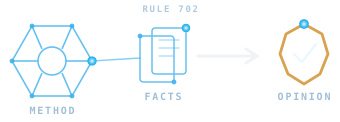
Amended Rule 702 of the Federal Rules of Evidence, effective December 2023, sharpened the question every expert opinion must answer: does it reflect a reliable application of reliable methods to the facts of the case?
Case-mapping is built for that question, and for its state-court analogues. The method is documented, the application is visible, and every finding traces to a Bates-numbered page or other identifiable parts of the production the court can check.
Every material fact on a timeline, tied to its source page and to the issues it bears on.
How the loss estimate moved across revisions, and who handled each change.
Every adjuster, inspector, and expert mapped to their role in the file.
Gaps and duplicate pages flagged before analysis begins.
Every quoted passage verified against the source before it reaches the report.
Timelines and exhibits built directly from the mapped record.
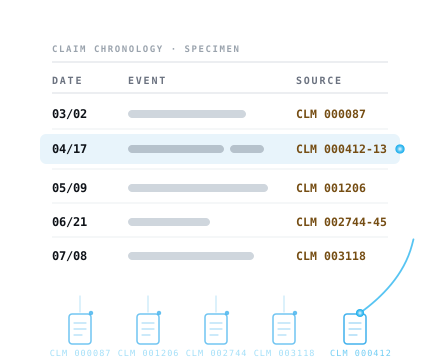
For a litigator, the most persuasive proof of a method is not a diagram of the method; it is a specimen of the work product. One chronology row showing the date, the event, and the Bates cite says more than a page of process copy.
The result for counsel: a citation-dense, demonstrative-ready analysis that stands up on cross-examination, because every finding traces back to a Bates number.
Tell us about the matter and we will map the record.